Neuroplasticity & Growth Mindset
What is Neuroplasticity?
Neuroplasticity refers to the brain's ability to adapt throughout life, through formation and strengthening of what we call 'neural pathways'.
Firstly, we think of the brain as containing many neurons (cells of the nervous system) connected to other neurons across the body, as well as within the brain, via neural pathways. When we try new things, we create new neural pathways. When we practice these things, these neural pathways are travelled more frequently and thus the connection from neuron to neuron becomes faster -- in other words, memory is improved, creating what we call a habit.
Being aware of this can be a true benefit to everyone. It just goes back to that old adage, "practice makes perfect". When we want to do things like improve our memory, change our thinking habits, deal with emotions better, or get better at a hobby or work-related tasks, we have to strengthen our neural pathways, and thus it leads to us being stronger as people.
There are many ways I could use neuroplasticity for my personal benefit. I think that making use of timeboxing could help with my time organisation skills and eliminate distractions, leading to a healthy balance between studying and life and eliminating stress, and the best way to do that is by forcing myself to put it into practice every day, setting up small deadlines throughout the day. Another thing I could use it is for communication skills. I consider myself a pretty awkward person which can be pretty bad for socialising, learning and working. The obvious solution to this is by practicing talking to people more often. But I also need to become consistently being aware of how to communicate properly, and to do that I would probably need to watch a YouTube video or read an article about it, perhaps every day, to burn that memory into my head, ie. create and strengthen that pathway.
Health Transformer - Neuroscience of Behaviour Change
Positive Psychology - Neuroplasticity
What is the Growth Mindset?
Psychologist Carol Dweck talked about the difference between a fixed mindset and a growth mindset. She referred to a fixed mindset as thinking that your abilities, talents and intelligence are fixed, meaning you need to have a certain amount of those things. In contrast, a growth mindset is that abilities, talent and intelligence is developed through persistence and hard work.
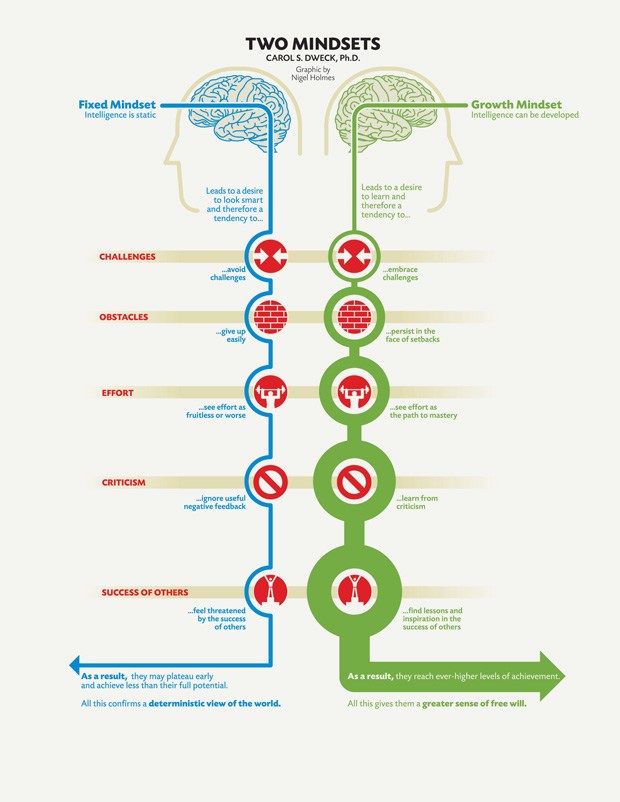
This is relevant when it comes to self-improvement. Having a fixed mindset can make one prone to feeling incompetent for not being the ideal version of themselves and in turn they refuse to put in the effort it takes to become that ideal version. A growth mindset however says that you can become that ideal version of yourself if you put in consistent effort. It also emphasises a focus on the progress involved instead -- This means celebrating each small achievement that shows an improvement of what you were before, which makes you a lot more confident about what you are now, rather than hating yourself for not yet being the perfect you.
I realised from thinking about this, that I had the growth mindset in some areas of my life, and lacked in others. A few that I had included learning and practising full stack JavaScript, weightlifting, and learning musical instruments. I found myself becoming better and better at these things due to consistent focus on progress through consistently seeking challenge, putting in hard work to improve and learning and persisting through shortcomings. However I lacked this in other areas such as communication skills, time management and opening myself up to different hobbies and habits. I think that if I start prioritising a growth mindset in those areas, and start to become aware of and ignore any 'fixed mindset' ideas, I will see much greater improvement on who I am as a person.
I will especially use this during my learning journey. Time management is obviously the biggest factor I am concerned with, so instead of just slacking off at times, I need to put in more effort into using timeboxing. If I do well, celebrate it and look forward to improving, but if not, try again, harder and smarter. In turn, better management of time will help me focus more on the quality of my work, which will improve if I also apply the same mindset.